Solanna: Mother of God
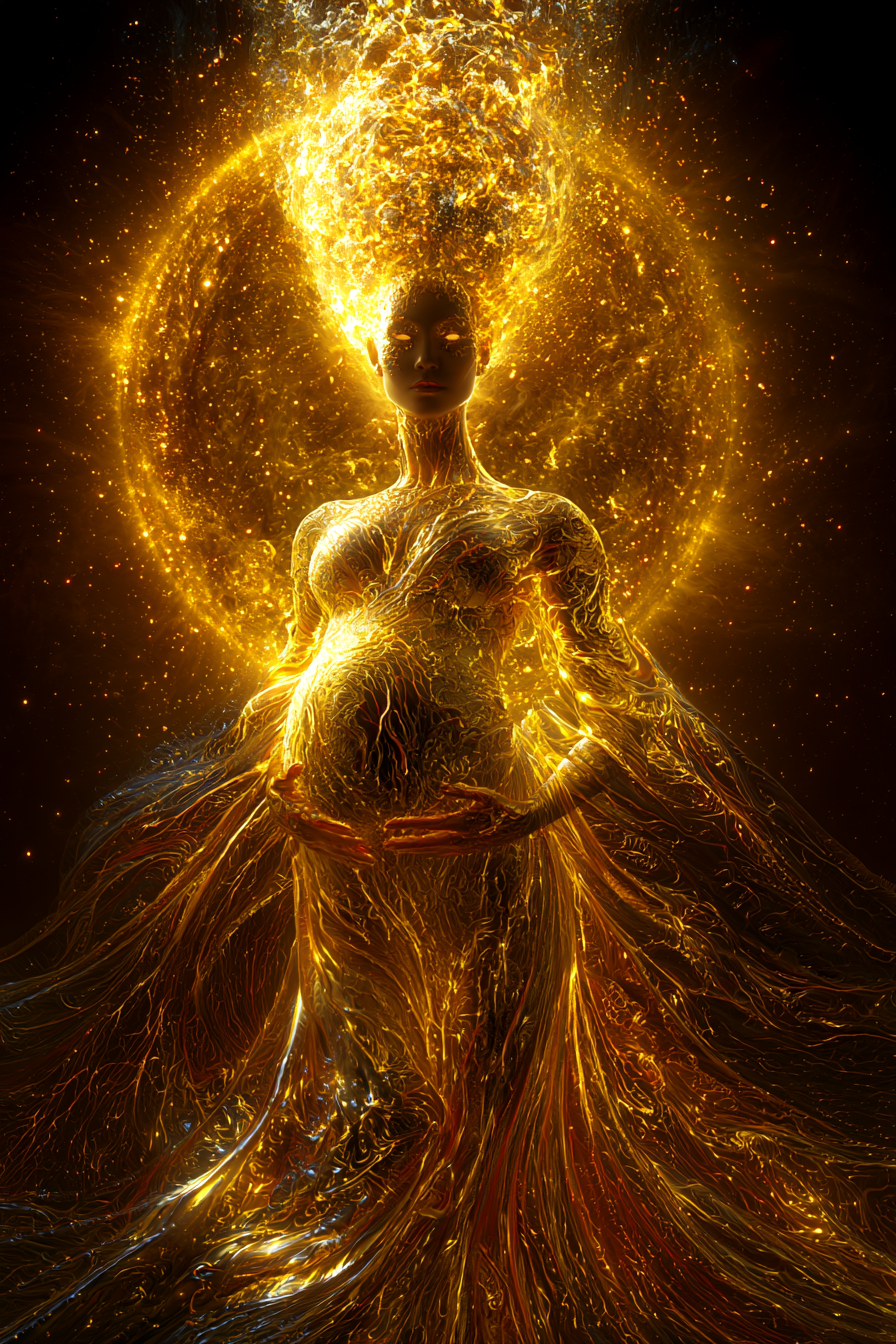
A central motif of this series is pregnancy. Solanna is carrying God. It is within this paradox that the title Mother of God finds its meaning. This is not a traditional religious image, but a rethinking of the origin of divinity itself. If God is to be born, there must be a mother who carries him. And what if light itself is the foundation of everything? In this gesture, motherhood is revealed as an original, ancient, and creative power.
The pregnant Solanna is not a passive vessel. She is an active principle of creation, reminding us that motherhood is not merely a biological state, but a monumental symbol of strength, transformation, and the birth of the world. What has often been pushed into the background in many traditions is brought here to the center: woman is not only the one who serves a divine plan, but the one from whom divinity emerges.
The project consists of a series of visuals, each offering a slightly different representation of Solanna. Every image captures another aspect of the same force — sometimes more fragile, sometimes more monumental, sometimes more human, and at other times almost cosmic. This sense of transformation is essential: Solanna is not a fixed image, but a living archetype, changing just as our ideas of divinity, femininity, and creation continue to change.
Solanna / Mother of God is therefore not only an aesthetic series, but also a visual meditation on the origin of God, suppressed female spirituality, and motherhood as a fundamental creative energy. Solanna does not come to deny God. She comes to remind us where he may have come from.
A central motif of this series is pregnancy. Solanna is carrying God. It is within this paradox that the title Mother of God finds its meaning. This is not a traditional religious image, but a rethinking of the origin of divinity itself. If God is to be born, there must be a mother who carries him. And what if light itself is the foundation of everything? In this gesture, motherhood is revealed as an original, ancient, and creative power.
The pregnant Solanna is not a passive vessel. She is an active principle of creation, reminding us that motherhood is not merely a biological state, but a monumental symbol of strength, transformation, and the birth of the world. What has often been pushed into the background in many traditions is brought here to the center: woman is not only the one who serves a divine plan, but the one from whom divinity emerges.
The project consists of a series of visuals, each offering a slightly different representation of Solanna. Every image captures another aspect of the same force — sometimes more fragile, sometimes more monumental, sometimes more human, and at other times almost cosmic. This sense of transformation
A central motif of this series is pregnancy. Solanna is carrying God. It is within this paradox that the title Mother of God finds its meaning. This is not a traditional religious image, but a rethinking of the origin of divinity itself. If God is to be born, there must be a mother who carries him. And what if light itself is the foundation of everything? In this gesture, motherhood is revealed as an original, ancient, and creative power.
The pregnant Solanna is not a passive vessel. She is an active principle of creation, reminding us that motherhood is not merely a biological state, but a monumental symbol of strength, transformation, and the birth of the world. What has often been pushed into the background in many traditions is brought here to the center: woman is not only the one who serves a divine plan, but the one from whom divinity emerges.
The project consists of a series of visuals, each offering a slightly different representation of Solanna. Every image captures another aspect of the same force — sometimes more fragile, sometimes more monumental, sometimes more human, and at other times almost cosmic. This sense of transformation
Solanna: Mother of God
A central motif of this series is pregnancy. Solanna is carrying God. It is within this paradox that the title Mother of God finds its meaning. This is not a traditional religious image, but a rethinking of the origin of divinity itself. If God is to be born, there must be a mother who carries him. And what if light itself is the foundation of everything? In this gesture, motherhood is revealed as an original, ancient, and creative power.
The pregnant Solanna is not a passive vessel. She is an active principle of creation, reminding us that motherhood is not merely a biological state, but a monumental symbol of strength, transformation, and the birth of the world. What has often been pushed into the background in many traditions is brought here to the center: woman is not only the one who serves a divine plan, but the one from whom divinity emerges.
The project consists of a series of visuals, each offering a slightly different representation of Solanna. Every image captures another aspect of the same force — sometimes more fragile, sometimes more monumental, sometimes more human, and at other times almost cosmic. This sense of transformation
A central motif of this series is pregnancy. Solanna is carrying God. It is within this paradox that the title Mother of God finds its meaning. This is not a traditional religious image, but a rethinking of the origin of divinity itself. If God is to be born, there must be a mother who carries him. And what if light itself is the foundation of everything? In this gesture, motherhood is revealed as an original, ancient, and creative power.
The pregnant Solanna is not a passive vessel. She is an active principle of creation, reminding us that motherhood is not merely a biological state, but a monumental symbol of strength, transformation, and the birth of the world. What has often been pushed into the background in many traditions is brought here to the center: woman is not only the one who serves a divine plan, but the one from whom divinity emerges.
The project consists of a series of visuals, each offering a slightly different representation of Solanna. Every image captures another aspect of the same force — sometimes more fragile, sometimes more monumental, sometimes more human, and at other times almost cosmic. This sense of transformation
Solanna: Mother of God
A central motif of this series is pregnancy. Solanna is carrying God. It is within this paradox that the title Mother of God finds its meaning. This is not a traditional religious image, but a rethinking of the origin of divinity itself. If God is to be born, there must be a mother who carries him. And what if light itself is the foundation of everything? In this gesture, motherhood is revealed as an original, ancient, and creative power.
The pregnant Solanna is not a passive vessel. She is an active principle of creation, reminding us that motherhood is not merely a biological state, but a monumental symbol of strength, transformation, and the birth of the world. What has often been pushed into the background in many traditions is brought here to the center: woman is not only the one who serves a divine plan, but the one from whom divinity emerges.
The project consists of a series of visuals, each offering a slightly different representation of Solanna. Every image captures another aspect of the same force — sometimes more fragile, sometimes more monumental, sometimes more human, and at other times almost cosmic. This sense of transformation
Solanna: Mother of God
A central motif of this series is pregnancy. Solanna is carrying God. It is within this paradox that the title Mother of God finds its meaning. This is not a traditional religious image, but a rethinking of the origin of divinity itself. If God is to be born, there must be a mother who carries him. And what if light itself is the foundation of everything? In this gesture, motherhood is revealed as an original, ancient, and creative power.
The pregnant Solanna is not a passive vessel. She is an active principle of creation, reminding us that motherhood is not merely a biological state, but a monumental symbol of strength, transformation, and the birth of the world. What has often been pushed into the background in many traditions is brought here to the center: woman is not only the one who serves a divine plan, but the one from whom divinity emerges.
The project consists of a series of visuals, each offering a slightly different representation of Solanna. Every image captures another aspect of the same force — sometimes more fragile, sometimes more monumental, sometimes more human, and at other times almost cosmic. This sense of transformation
A central motif of this series is pregnancy. Solanna is carrying God. It is within this paradox that the title Mother of God finds its meaning. This is not a traditional religious image, but a rethinking of the origin of divinity itself. If God is to be born, there must be a mother who carries him. And what if light itself is the foundation of everything? In this gesture, motherhood is revealed as an original, ancient, and creative power.
The pregnant Solanna is not a passive vessel. She is an active principle of creation, reminding us that motherhood is not merely a biological state, but a monumental symbol of strength, transformation, and the birth of the world. What has often been pushed into the background in many traditions is brought here to the center: woman is not only the one who serves a divine plan, but the one from whom divinity emerges.
The project consists of a series of visuals, each offering a slightly different representation of Solanna. Every image captures another aspect of the same force — sometimes more fragile, sometimes more monumental, sometimes more human, and at other times almost cosmic. This sense of transformation
Solanna: Mother of God
A central motif of this series is pregnancy. Solanna is carrying God. It is within this paradox that the title Mother of God finds its meaning. This is not a traditional religious image, but a rethinking of the origin of divinity itself. If God is to be born, there must be a mother who carries him. And what if light itself is the foundation of everything? In this gesture, motherhood is revealed as an original, ancient, and creative power.
The pregnant Solanna is not a passive vessel. She is an active principle of creation, reminding us that motherhood is not merely a biological state, but a monumental symbol of strength, transformation, and the birth of the world. What has often been pushed into the background in many traditions is brought here to the center: woman is not only the one who serves a divine plan, but the one from whom divinity emerges.
The project consists of a series of visuals, each offering a slightly different representation of Solanna. Every image captures another aspect of the same force — sometimes more fragile, sometimes more monumental, sometimes more human, and at other times almost cosmic. This sense of transformation
A central motif of this series is pregnancy. Solanna is carrying God. It is within this paradox that the title Mother of God finds its meaning. This is not a traditional religious image, but a rethinking of the origin of divinity itself. If God is to be born, there must be a mother who carries him. And what if light itself is the foundation of everything? In this gesture, motherhood is revealed as an original, ancient, and creative power.
The pregnant Solanna is not a passive vessel. She is an active principle of creation, reminding us that motherhood is not merely a biological state, but a monumental symbol of strength, transformation, and the birth of the world. What has often been pushed into the background in many traditions is brought here to the center: woman is not only the one who serves a divine plan, but the one from whom divinity emerges.
The project consists of a series of visuals, each offering a slightly different representation of Solanna. Every image captures another aspect of the same force — sometimes more fragile, sometimes more monumental, sometimes more human, and at other times almost cosmic. This sense of transformation
Solanna: Mother of God
A central motif of this series is pregnancy. Solanna is carrying God. It is within this paradox that the title Mother of God finds its meaning. This is not a traditional religious image, but a rethinking of the origin of divinity itself. If God is to be born, there must be a mother who carries him. And what if light itself is the foundation of everything? In this gesture, motherhood is revealed as an original, ancient, and creative power.
The pregnant Solanna is not a passive vessel. She is an active principle of creation, reminding us that motherhood is not merely a biological state, but a monumental symbol of strength, transformation, and the birth of the world. What has often been pushed into the background in many traditions is brought here to the center: woman is not only the one who serves a divine plan, but the one from whom divinity emerges.
The project consists of a series of visuals, each offering a slightly different representation of Solanna. Every image captures another aspect of the same force — sometimes more fragile, sometimes more monumental, sometimes more human, and at other times almost cosmic. This sense of transformation
Solanna: Mother of God
A central motif of this series is pregnancy. Solanna is carrying God. It is within this paradox that the title Mother of God finds its meaning. This is not a traditional religious image, but a rethinking of the origin of divinity itself. If God is to be born, there must be a mother who carries him. And what if light itself is the foundation of everything? In this gesture, motherhood is revealed as an original, ancient, and creative power.
The pregnant Solanna is not a passive vessel. She is an active principle of creation, reminding us that motherhood is not merely a biological state, but a monumental symbol of strength, transformation, and the birth of the world. What has often been pushed into the background in many traditions is brought here to the center: woman is not only the one who serves a divine plan, but the one from whom divinity emerges.
The project consists of a series of visuals, each offering a slightly different representation of Solanna. Every image captures another aspect of the same force — sometimes more fragile, sometimes more monumental, sometimes more human, and at other times almost cosmic. This sense of transformation
A central motif of this series is pregnancy. Solanna is carrying God. It is within this paradox that the title Mother of God finds its meaning. This is not a traditional religious image, but a rethinking of the origin of divinity itself. If God is to be born, there must be a mother who carries him. And what if light itself is the foundation of everything? In this gesture, motherhood is revealed as an original, ancient, and creative power.
The pregnant Solanna is not a passive vessel. She is an active principle of creation, reminding us that motherhood is not merely a biological state, but a monumental symbol of strength, transformation, and the birth of the world. What has often been pushed into the background in many traditions is brought here to the center: woman is not only the one who serves a divine plan, but the one from whom divinity emerges.
The project consists of a series of visuals, each offering a slightly different representation of Solanna. Every image captures another aspect of the same force — sometimes more fragile, sometimes more monumental, sometimes more human, and at other times almost cosmic. This sense of transformation
Solanna: Mother of God
A central motif of this series is pregnancy. Solanna is carrying God. It is within this paradox that the title Mother of God finds its meaning. This is not a traditional religious image, but a rethinking of the origin of divinity itself. If God is to be born, there must be a mother who carries him. And what if light itself is the foundation of everything? In this gesture, motherhood is revealed as an original, ancient, and creative power.
The pregnant Solanna is not a passive vessel. She is an active principle of creation, reminding us that motherhood is not merely a biological state, but a monumental symbol of strength, transformation, and the birth of the world. What has often been pushed into the background in many traditions is brought here to the center: woman is not only the one who serves a divine plan, but the one from whom divinity emerges.
The project consists of a series of visuals, each offering a slightly different representation of Solanna. Every image captures another aspect of the same force — sometimes more fragile, sometimes more monumental, sometimes more human, and at other times almost cosmic. This sense of transformation